
Understanding Uw, Ug and Uf values
Uw, Ug and Uf are thermal transmittance values expressed in W/(m²·K). Ug applies to the glazing, Uf to the frame and Uw to the complete window. A lower value means less heat transfer. Compare Uw figures only when the window dimensions and configuration are equivalent.
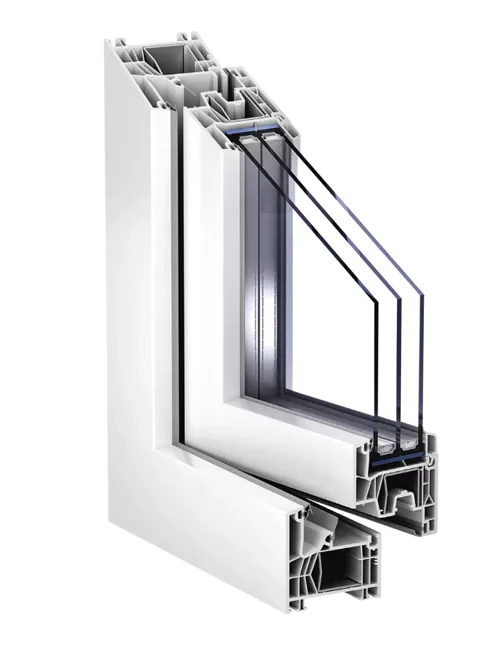
Uw, Ug and Uf at a glance
The three figures describe heat transfer through different parts of a window. A useful comparison must state the unit, tested configuration and, for Uw, the reference dimensions.
| Value | Component | How to read it |
|---|---|---|
| Ug | Glazing | Lower means less heat transfer through the glass |
| Uf | Frame and sash | Depends on material, profile and reinforcement |
| Uw | Complete window | Combines glass, frame, dimensions and spacer |
Ug — the glazing coefficient
Ug applies only to the glazing. Depending on its construction, modern double glazing may for example be declared around Ug 1.0 to 1.1, while some triple glazing is around 0.5 to 0.7. Always request the declaration for the glazing actually offered.
Uf — the frame coefficient
Uf describes the frame and sash. It varies with the material, profile depth, insulating chambers, reinforcement and thermal breaks. Because the proportion of frame changes with window size, Uf alone does not predict the final Uw.
Uw — the overall window coefficient
Uw combines glazing and frame areas with the linear effect of the spacer. It is calculated using standards including the EN ISO 10077 series. The product value does not automatically include every effect of the wall junction. The current Minergie Window module states a maximum U-value of 1.0 W/(m²·K), while a specific project must follow its chosen standard and canton rules.
What these values mean for your project
At the same area and temperature difference, a component with Uw 1.4 theoretically transfers twice as much heat as one with Uw 0.7. That does not by itself prove an annual saving: window area, climate, heating system, solar gains, airtightness and installation all affect the result.
Examples from our supplier systems
Kömmerling states a standard Uf of 0.95 W/(m²·K) and glazing up to 58 mm for Kömmerling 88. Depending on the variant, Kömmerling 76 achieves about Uf 1.0 W/(m²·K). Aluprof MB-86N uses thermally broken aluminium profiles and is available in ST and SI variants. These are system or frame data; final Uw must still be calculated using the glazing, spacer and actual dimensions.
How to compare two quotations
Request Uw for the actual dimensions or a clearly stated reference size. Also check Ug, Uf, the spacer, solar g-value, acoustic performance and installation method.
- Compare similar dimensions and opening types.
- Check that the unit and calculation standard are stated.
- Distinguish a system, glazing or complete-window value.
- Assess installation joints, airtightness and thermal bridges separately.
Related guidance
Need personalised advice?
BO Fenster answers all your technical questions and prepares a free quote for you within 24h.
Request a free quoteFrequently asked questions
Quick answers
What is the difference between Uw and Ug?
Ug applies only to the glazing. Uw applies to the complete window and includes the glazing, frame, dimensions and spacer.
Is a lower Uw value always better?
A lower Uw means less heat transfer in the calculated configuration. Solar gains, acoustics, ventilation, budget and installation must also be considered.
Does Uw include window installation?
The product Uw generally does not include every effect of the connection between the window and wall. Joint design, airtightness and thermal bridges remain important.
Can two brochure Uw values be compared?
Only when dimensions, glazing, frame, spacer and calculation method are comparable.